Hair loss is a unique and unsettling experience that clinic owner and Trichologist Alexie Hylton knows all too well. Ten years ago, she was diagnosed with trichorrhexis nodosa (TN) which left her devastated and filled anxiety. After embarking on a successful treatment plan that led to significant hair growth within three months, Hylton now offers a personalised service helping women diagnose the problem and find solutions to help restore their confidence.
To navigate through the causes of hair loss and offer guidance on how to treat and prevent it, we talk to Hylton about her personal experience and why more women are experiencing it today.
Your interest in trichology came after the loss of your own hair. Can you tell us what happened to make you lose your hair?
After regular relaxer use, my hair became over-processed. It was dry, brittle and extremely porous. I should have waited a few months between relaxing, yet my hair was thick and unmanageable. Once the relaxer was applied and washed out instantly, my hair began to break from the roots. I only relaxed the crown area, but within days this area went bald.

You say you noticed regrowth in your hair after three months of following a treatment plan. What was involved in this process?
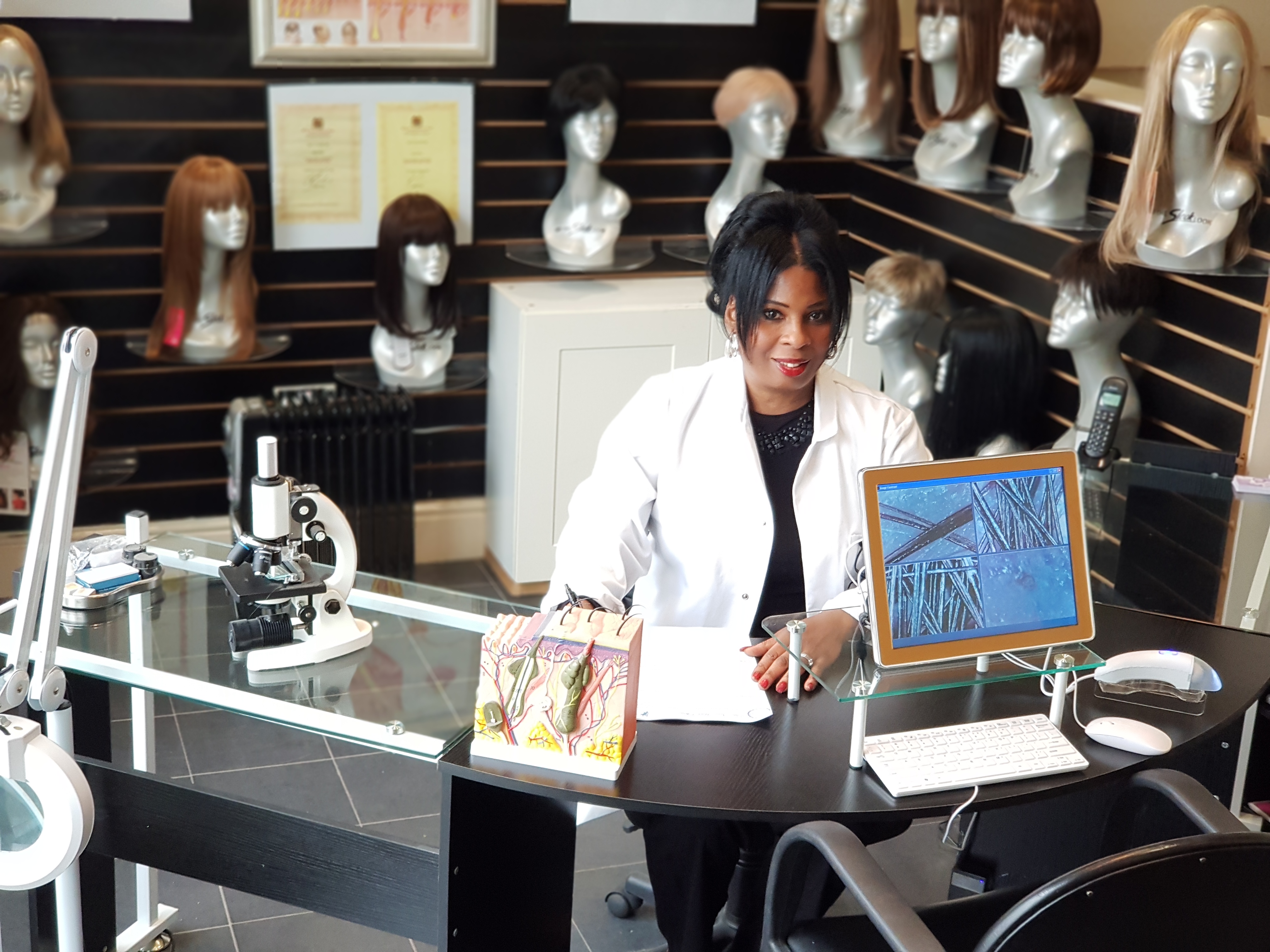
I viewed my hair follicles with a dermascope – a camera which enabled me to see my hair follicles. Each one was like a tree that was stripped, like it had gone through a storm. After intensive research, I found a Trichologist who diagnosed me with trichorrhexis nodosa (TN), also known as ‘chemical hair trauma’. I was given a course of hair treatments and products to start using immediately. Within a month after my first visit, I noticed 15% regrowth.
What does your hair and scalp care routine look like now?
I wear wigs because I adore them. Every other week I treat my hair with a deep treatment, then I create a canerow base for my wig and this base also helps my hair grow. When I go on holiday, however, I like my own natural hair out. I have thick Afro-Caribbean hair which I have texturised twice a year.
What’s your advice to any woman who has lost their confidence due to hair loss?
I would advise them to book a consultation with a Trichologist like myself. They can provide a thorough appointment, covering health, medication and lifestyle. They can also recommend products and a treatment plan for up to four months. If you have one of the scarring alopecias that often carry permanent hair loss, I would recommend seeing a wig specialist to order a bespoke, customised hair system or a conventional wig.
“We offer a free consultation on all wigs, and customers are welcome to select a wig in the show room and try it on”

What are your customers’ first concerns when they come to you for a wig consultation, and how do you help them overcome these concerns?
Most clients are so embarrassed about their hair loss that they want the consultation done privately. They also want a wig that looks natural, so that people don’t realise that they are wearing one. In addition, my experience has taught me that people like to talk about what has caused their hair loss, including personal issues. Privacy and a one-to-one consultation allows them to openly share this information.
At Elite 9 Hair Clinic, we have created a wig show room and we have a ‘before and after’ client portfolio where we do not show the clients’ faces. We offer a free consultation on all wigs, and customers are welcome to select a wig in the show room and try it on. We offer a selection of bespoke wigs made especially for them, creating their own unique template. If they like a certain wig, yet would love another colour, we can order it in, which usually takes a few days.
Does wearing a wig prevent hair growth?
I have been wearing a wig for over 20 years, and I’ve seen my hair grow and grow. One must look after the natural hair under the wig. I would recommend braiding under the wig with a regular treatment plan in place, such as a deep conditioning treatment once or twice, every four weeks. In addition, wear a silk scarf or bonnet while sleeping, as this ensures that the hair gets plenty of moisture.
What should you do if you start to notice that you’re losing hair?
Book a consultation with Trichologist, as we are experts in hair and scalp conditions. As Trichologists, we help clients with numerous types of hair loss conditions, such as Alopecia areata(AA), female pattern hair loss, frontal fibrosing alopecia, trichotillomania, and many other hair loss symptoms or scalp conditions. We often see clients who are not aware they are suffering from an autoimmune disorder until they see their hair shedding or falling out.
As Trichologists, we often refer many patients for blood tests to detect low iron/ferritin and B12, or high levels of testosterone, which can be caused by polycystic ovary syndrome (PCOS). Many of these conditions can contribute to hair loss, and there are multiple conditions that can interfere with the hair’s natural growth cycle. As Trichologists, we ask many intrusive questions, but our objective is to find the root of the problem causing the hair loss.

Once a hair follicle dies, it doesn’t come back. Is that true?
This really does depend on if the hair follicle is permanently damaged, such as in alopecia universalis (AU), a condition that results in complete hair loss. Another chronic hair loss condition – alopecia totalis (AT) – is a severe type of hair loss where the client has complete and permanent hair loss of the scalp.
Some people find that their hair grows back a different texture after losing it (for example, after chemotherapy). Why does this happen?
Chemotherapy medication can remain in the patient’s body for some time, and this causes the hair follicles to change shape, causing the hair to grow differently.
“I am seeing an alarming number of young women suffering from hair loss in their late twenties to early thirties”
Besides medical conditions such as alopecia, what’s the number one cause of hair loss in women? And how can we fight it?
More recently, I am seeing an alarming number of young women suffering from hair loss in their late twenties to early thirties. Telogen effluvium (TE), which is a temporary hair loss, is becoming particularly common. It causes the patient anxiety and depression, and many lose their confidence. TE can be caused by stress, bad diet and nutritional deficiency, a sudden change in hormone levels, childbirth, recent operations, different medications, overactive or under active thyroid, iron deficiency, crash diets, lupus, diabetes and eating disorders.
The most common cause of hair loss is stress. As Trichologists, we talk to the patient about what they can do to help control their stress levels. We then create an action plan, for example regular gym visits, walking the dog or going on relaxing holidays. When we see a patient who is suffering from depression brought on by the death of a partner, the loss of a job or a recent divorce, for example, we often refer them to a counselor.
Postmenopausal women, or those going through the menopause, can also start to lose their hair during this time. The hair can become very thin, and is often referred to as female pattern hair loss. This condition usually effects the crown area. During the menopause, over 52% of women start to lose their hair, or the hair is visibly thinner all over. This is due to the decrease in the hormones estrogen and progesterone. When these hormones decrease, the level of androgens (male sex hormones) rise, and these androgens decrease the number of hair follicles.
Once successfully diagnosed, using questions covering health, medication, lifestyle and diet, we can then create a treatment plan.


What kind of medicines are known for causing hair loss?
Blood thinners, hormone related drugs, thyroid medication, various antidepressants, hormone replacement therapies and various types of steroids.
What kind of vitamins and supplements should we take to prevent hair loss?
Healthy hair needs a combination of minerals and vitamins. I recommend Philip Kingsley Density Healthy Hair Complex; I use this myself and pass it onto my friends and family. It’s especially appropriate for women who are premenopausal or menopausal.
Philip Kingsley Elasticizer Extreme is another fantastic product that produces exceptional results. It’s a deep conditioning treatment specifically for afro hair. Try it – you will not be disappointed.
Many women with textured hair use oils to care for their hair and scalp – but what kind of product is best to use for stronger hair?
Personally, I have seen exceptional results with KeraCare Natural Textures Leave in Conditioner. Their Overnight Moisturizing Treatment is also a wonderful product for women with dry hair, and it’s great on natural hair. In addition, the Affirm Positive Link is a deep intensive treatment, and is a useful product for growing healthy hair.
Regular visits to your salon for a deep treatment will certainly speed up your hair growth, as will a well-maintained diet. Hair follicles are made of 90% protein; therefore, it’s advised to add more protein to your diet for healthy hair.
Visit Elite 9 Hair Clinic’s website at elite9hairclinic.co.uk
Shop Alexie’s picks

Philip Kingsley Density Healthy Hair Complex, £25.50 for 60 tablets


Affirm Positive Link, £24.19