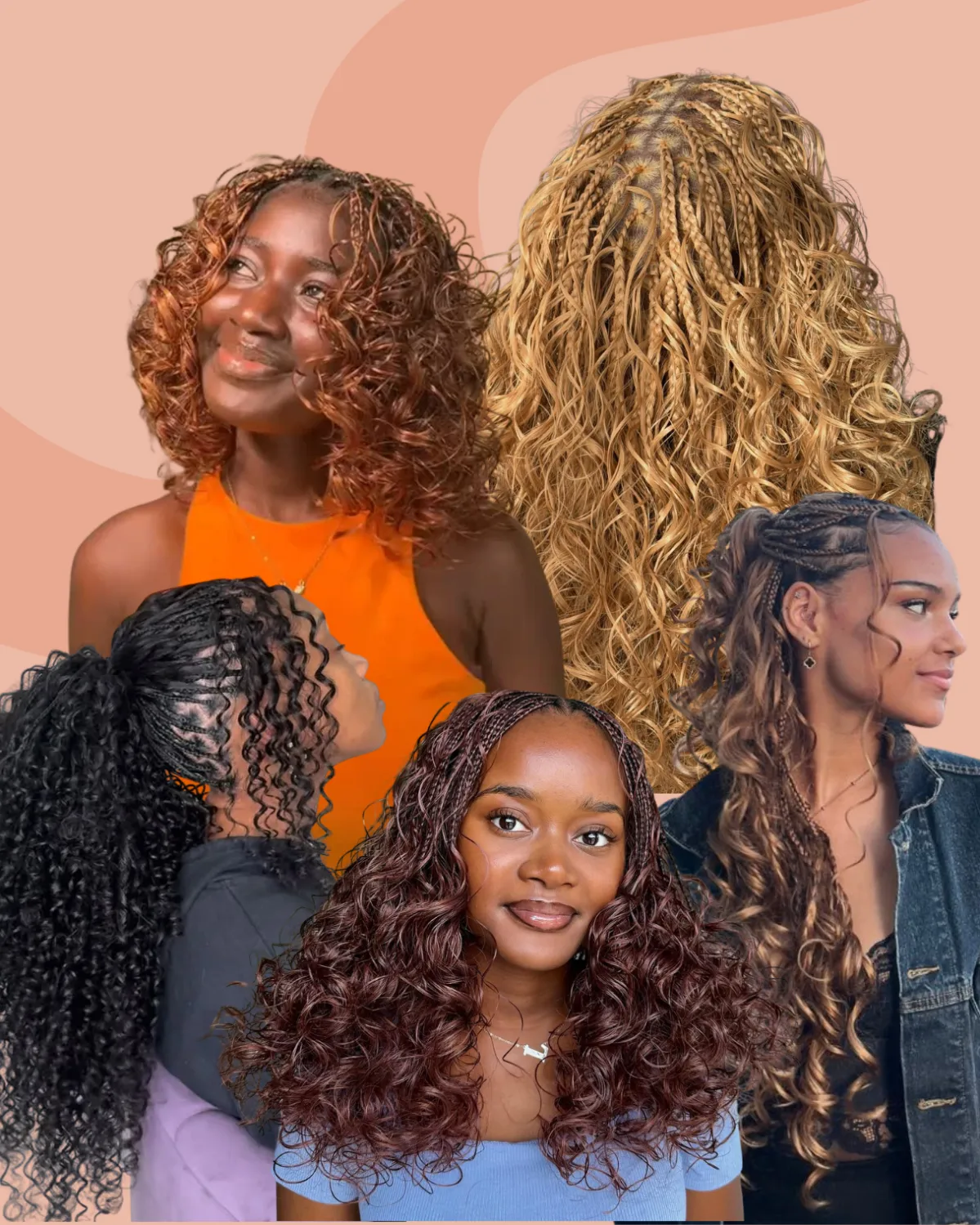
If you’ve noticed braids looking a little different this summer – less beachy, more glossy, but still fun – chances are you’ve already seen Italian curls without realising it.
They’re the curl pattern taking the reigns from boho braids, knotless styles and mermaid-inspired installs, adding a soft but structured finish that appears a touch more “done” than the looser curl trends we’ve been seeing recently. This style’s all about defined ringlets, noticeable volume, and expensive-looking dimension that holds its shape.
Despite the name, Italian curls aren’t about geography so much as aesthetics. They’re a trade term used in the hair industry to describe a very specific kind of curl texture – one that sits neatly between relaxed wave and full spiral curl, and has become a go-to for anyone wanting their protective style to look a bit more elevated without losing its ease.
If French curls are the carefree holiday version of braids, Italian curls are their more put-together cousin – still relaxed and super wearable, but more structured in how they fall.
What are Italian curls?
Italian curls refer to a premium curl texture available in both synthetic and human hair extensions. The hair features soft, defined ringlets that sit somewhere between loose waves and tighter curls, creating an elegant, full-bodied look.
The texture has become particularly popular in protective styles, where straight or braided sections transition into flowing curls through the lengths or at the ends. This results in a style that’s glamorous while still looking relaxed and natural.
While the name suggests an Italian origin, “Italian curls” is primarily a trade name used within the hair industry to describe this particular curl pattern rather than indicating that the hair itself comes from Italy.
What are Italian curls used for?
Italian curls are incredibly versatile and can be used in a variety of hairstyles, including:
- Boho braids
- Knotless braids
- Mermaid braids
- Sew-in weaves
- Custom wigs
- Quick weaves
Many people choose Italian curls to soften the appearance of traditional braids, allowing defined curls to frame the face or fall freely through the lengths for extra movement.
The texture is available as both loose braiding hair and bundled extensions, making it suitable for a wide range of installation methods.
Italian curls vs French curls: What’s the difference?
Italian curls and French curls share a similar soft, romantic appearance, but there is one noticeable difference.
Italian curls have tighter, more defined and consistent ringlets, giving the finished hairstyle greater volume and structure.
French curls, by comparison, feature looser, more relaxed curls that create an airier, softer finish.
Choosing between the two largely comes down to personal preference. Those looking for a fuller, more defined look may prefer Italian curls, while French curls offer a slightly more understated effect.
How do you achieve Italian curls?
Italian curls are created using specialised braiding or extension hair rather than styling natural hair into the curl pattern.
For a full head of braids, most styles require between two and four packs of extension hair, depending on the desired length and thickness.


Above, from left to right: X-Pression 12x Curly Body, £8.60; Empire Bulk – Water Wave Bulk, from £34.20; Outre X-Pression Pre-Sectioned Dominican Curl Bulk, £8.99
Because the fibres are often smooth and silky, experienced braiders maintain firm tension during installation to ensure the extensions remain secure within each braid.
The finished look can be customised with different braid sizes, lengths and colours, making Italian curls suitable for everything from subtle everyday styles to statement looks.
How do you care for Italian curls?
Like most curly extension styles, Italian curls benefit from regular maintenance to keep them looking fresh.
- Every few days, lightly mist the hair with a mixture of water and leave-in conditioner to maintain moisture and reduce dryness.
- Rather than brushing through the curls, gently separate them with your fingers to minimise tangling while preserving the curl pattern.
- Applying a lightweight mousse can also help define the curls, reduce frizz and keep the style looking polished between washes.
- Protecting the hair overnight with a silk bonnet or satin pillowcase can further extend the life of the style and reduce friction while sleeping.
Are Italian curls worth trying?
If you’re looking to add texture, movement and elegance to your next protective hairstyle, Italian curls are a great choice.
Their defined ringlets give you more structure than French curls while still delivering the relaxed, bohemian finish that continues to top hair trends.
It’s easy to understand why Italian curls have become one of the most requested extension textures of the moment!
Not sold? Browse our hair gallery below – and let us win you over: