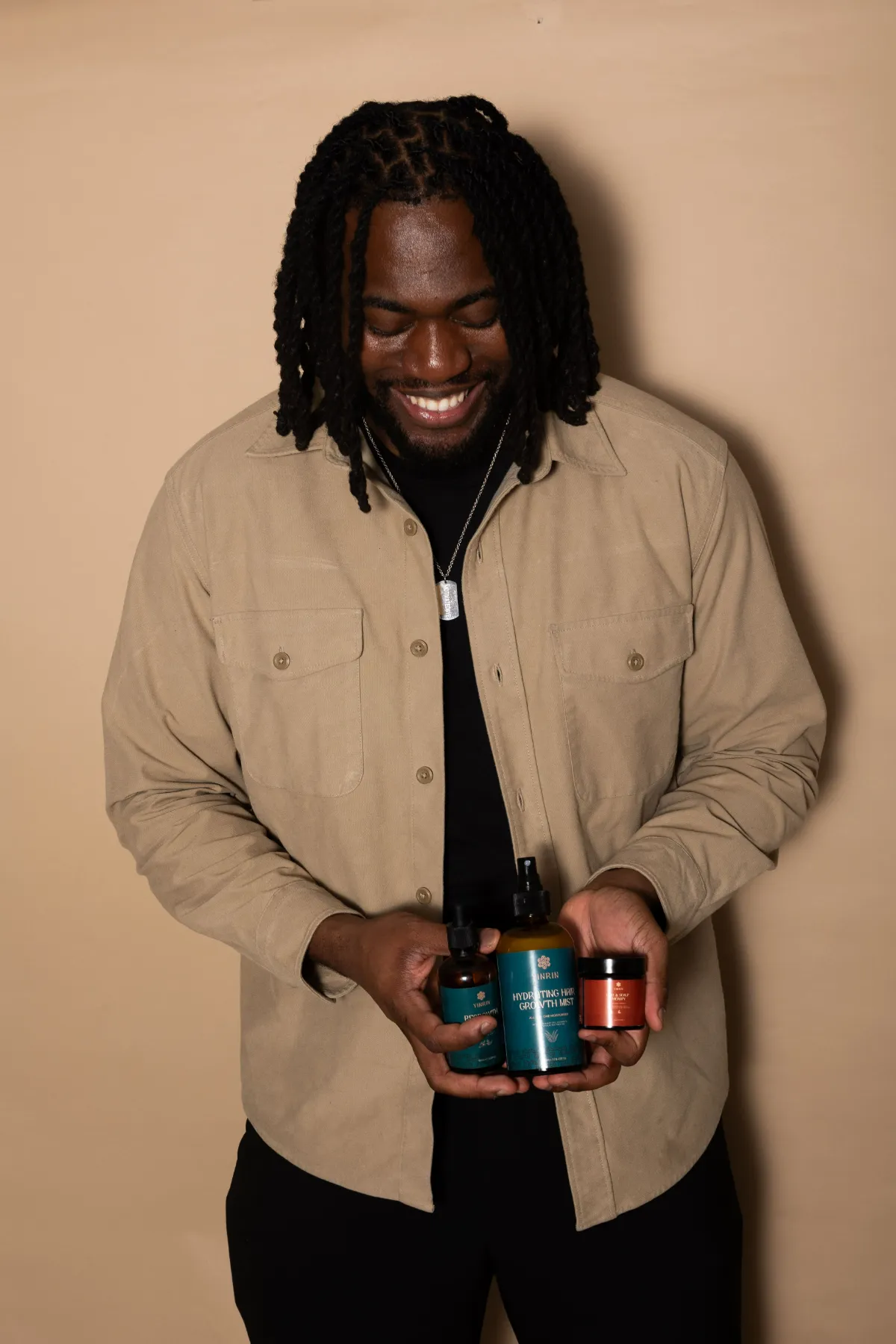
Emmanuel Abimbola’s journey with Yinrin started long before the brand itself, shaped by childhood days spent in his mother’s Peckham hair shop, an early instinct for business and, later, his own loc journey.
Today, Yinrin is a scalp-focused haircare brand, but it also encompasses and promotes community, education and a human approach to marketing.
We caught up with Emmanuel to talk entrepreneurship, natural hair, customer connection, the lessons behind the brand and why, for him, haircare has always been about more than the final result.
Yinrin was inspired by your childhood experiences in your mother’s hair shop in Peckham. What business lessons from those early years have stayed with you?
African hospitality is all about going above and beyond for your guests and clients, treating them with the same warmth and care you would give to family. I’ve carried that into every part of Yinrin. For me, customer service starts with understanding people’s needs, routines, and even their mindset towards their hair. It’s about making every customer feel heard and understood, and explaining haircare in a way that makes sense to them, regardless of their level of knowledge.
Another lesson I learned during those years came from the playground: supply and demand. My school had a lot of kids from low-income backgrounds, and the school lunches were expensive. Staying fuelled for lessons without breaking the bank was a challenge, so I started selling what we called “pound deals”. For £1, you got a packet of Doritos, a Capri-Sun, and a chocolate bar.
I would buy multipacks from different supermarkets on the high street to find the best deals and maximise my profit. The concept was a hit. Most days I’d sell out before lunchtime. Depending on the weather, I’d even wake up at 6am to freeze the drinks slightly so they were cold for everyone by break time. I was making around £25 a day. Looking back, you could say my entrepreneurial journey started right there.

Your own loc journey played a major role in the creation of the brand. What have you learned about your own hair that influenced Yinrin the most?
I’ve learned so much over the five years of my loc journey. From understanding essential oils and carrier oils, to wash day routines, scalp hydration, DHT blockers, alopecia, scalp stimulation, and ingredient efficacy. A lot of those lessons are reflected in both the ingredients and ethos of Yinrin.
I don’t include ingredients unless they serve a purpose. Early in my loc journey, I struggled with heavy build-up from gels and thick oils, so I wanted my products to be lightweight, with fewer filler ingredients and more active ingredients that actually contribute to scalp and hair health.
I documented my entire loc journey on YouTube and built a strong connection with my audience through that process. I even reacted to subscribers’ loc journeys, and that’s where the idea of documenting other people’s hair journeys came from. I wanted to create transparency around the real struggles people face with their hair, engage the community through relatable stories, and highlight the stylists and salons supporting natural haircare. Hair isn’t just about the final result—it’s about the journey.
If you could give your younger self one piece of haircare advice before starting your loc journey, what would it be?
Don’t use that Cantu leave-in conditioner! It had my hair falling out in clumps every day in the shower.
On a serious note, I’d tell my younger self to take ownership of his hair earlier. Grow it out, experiment with different styles, and don’t be afraid to look different. I’d also encourage him to learn styling techniques and even take styling classes. There aren’t enough men teaching other men how to style and care for their natural hair, and that’s something I would have loved to contribute to sooner.
Natural haircare has grown dramatically in popularity over the last two decades. What sets Yinrin apart from other natural brands?
We focus on helping people understand and improve their scalp health. Most people have no idea what’s actually happening on their scalp and tend to focus solely on styling or the finished look.
A lot of natural haircare brands focus on appearance, whereas we focus on the root of the issue—literally. Before blaming a stylist or styling product, we want to understand what’s happening underneath. Healthy hair starts with a healthy scalp.
We’re constantly looking at ways to improve our formulations and incorporate research-backed ingredients that genuinely support scalp and hair health. We want customers to understand their hair better, not just style it better.

Some of your products contain DHT blockers. Can you tell us more about what these are and how they benefit the hair and scalp?
DHT, or dihydrotestosterone, is a hormone that can contribute to hair thinning and hair loss in people who are genetically sensitive to it. Over time, DHT can shrink hair follicles, making it harder for healthy hair to grow.
DHT blockers are ingredients that may help reduce the impact of DHT on the scalp. While they aren’t a miracle cure, they can be a useful part of a healthy scalp routine, particularly for people experiencing thinning or looking to maintain hair density. We incorporate ingredients with research-backed benefits because our goal is to support the scalp environment and give hair the best possible conditions to thrive.
Yinrin’s Instagram page feels relatable and fun, often featuring you. Why was it important to share the reality behind the brand rather than presenting a polished corporate image?
I’ve worked as a social media manager, marketing manager, and content creator, so I’ve seen both sides of marketing. From my experience, people tend to avoid overly polished and scripted social media pages because they feel like one long advert.
I’ve learned that social media should create the atmosphere of your brand rather than constantly trying to sell. That’s what UGC and paid advertising are for. I try to separate the two. On Yinrin’s social channels, I focus on relatable haircare journeys, community stories, and the occasional funny skit because that’s what people genuinely connect with. It feels more human, and that’s what the brand is about.
You’ve attended Afro Hair & Beauty Live for four consecutive years. What keeps you coming back each year?
Honestly, it’s the people. I can talk about haircare all day.
I’m naturally an introvert, but I’m also a people person because of how I was raised. People tend to gravitate towards me and open up about their personal experiences, insecurities, and hair struggles without me even asking. I think it’s because I’m an open book myself.
When it comes to haircare, a lot of people feel more comfortable speaking to someone they can relate to rather than a large corporate brand. That direct connection is invaluable. It allows me to hear honest feedback, understand customer needs, and identify opportunities to improve existing products or develop new ones. Every year I leave with pages of notes and fresh motivation.

What does it feel like when someone returns year after year and trusts your products as part of their haircare routine?
It’s honestly surreal. It definitely triggers a bit of imposter syndrome sometimes.
I’ve had customers who first met me at Afro Hair & Beauty Live and have supported Yinrin every single year since, both at events and online. That level of loyalty is something I never take for granted.
Whenever I see those familiar faces, I usually end up blessing them with discounts, gift sets, or something extra because they’ve played such a huge role in keeping me motivated. Building a brand comes with financial challenges and personal sacrifices, so knowing people genuinely believe in what you’re creating gives you the energy to keep going.
Building a business is rarely easy. During the tougher moments, what helps you stay motivated and continue moving forward when things don’t go according to plan?
I’ve wanted to work for myself since I was 12 years old, so the idea of going to school solely to get a job never really existed for me.
Every milestone I’ve achieved has happened while juggling something else. I sold food throughout secondary school. I worked 28 hours a week while studying at college. I played basketball on scholarship in America while completing my degree and running an essay-writing business. I started YouTube and vlogging while playing professional basketball in Spain and Ireland. And I’ve built Yinrin while working multiple 9-to-5 roles.
I’ve always done things a little differently. So when business gets tough, I remind myself of the promise God gave me and focus on the next step in front of me.
I spend a lot of time reflecting on past challenges and future decisions. When I look back, most situations weren’t nearly as bad as they felt at the time. I also remind myself that I could choose the easier route at any point. I could stop taking risks and live a more conventional life. But I choose the difficult path because that’s where growth happens. Life would be too easy if I only did what everyone else was doing.
Imagine Yinrin in ten years’ time. What’s one thing you’d love people to say about the brand that would make you think, “We’ve done it”?
I’d love people to say that Yinrin made them feel seen.
We’ve always believed that every scalp has a story, every hair journey is different, and every routine is personal. If, ten years from now, we’ve successfully put our customers’ unique hair journeys at the centre of everything we do, I’d feel like we’ve achieved what we set out to do.
Our slogan is, “It’s more than just haircare.” I’d love for people to genuinely feel that when they think about Yinrin.