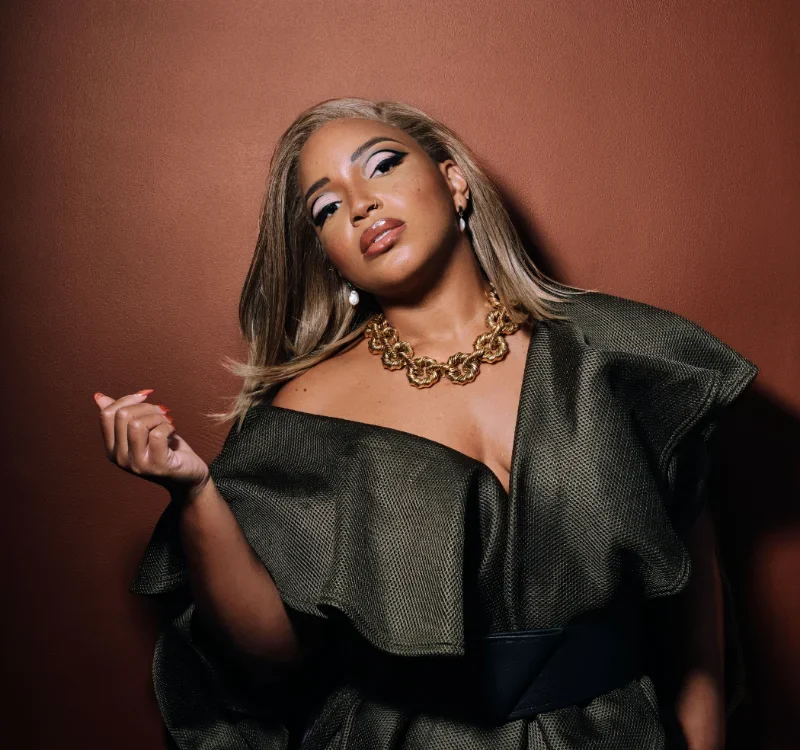
Having left behind the comfort and support of friends, family and a life and career in the USA to star on a West End stage, Marisha Wallace knows a thing or two about pursuing dreams. A last-minute call to fill in for Amber Riley in Dreamgirls saw her take a red-eye to London in 2017 and once she set foot on the tarmac, she never looked back. It was this move that launched the performer into stardom, landing her top billing in Waitress and Hairspray, and even a spot on Celebrity Big Brother. This year, the 39-year-old returns to London’s Adelphi Theatre for her biggest ever headline show, as well as taking the lead in stage classic Cabaret alongside Billy Porter. Could 2025 be her most exciting year yet?
You might believe that Cabaret is simply a fun ode to the Jazz Age, with its triumphant tunes and flapper costumes, but that’s far from the truth. Set against the backdrop of pre-World War II Berlin, main character Sally Bowles (portrayed by Marisha) yearns for a life of glamour and decadence amidst growing political tension in the country. “There’s so much history associated with this musical, and I’ve also learned about black history in Nazi Germany,” explains Wallace. “My character Sally is as layered as the storyline itself – tragic, ambitious, villainous, idealistic.” Previously typecast in “sassy Black girl” roles (Wallace’s words), the West End star’s CV now lists a string of roles that performers of any background could only dream of filling, from Miss Adelaide in Guys and Dolls, to Ado Annie in Oklahoma!, both of which earned her nominations for the prestigious Olivier Award. Between Cabaret rehearsals and planning her upcoming solo show setlist, Marisha takes a beat to talk to Spell about overcoming the limitations to being typecasted, life lessons from co-star Billy Porter, and caring for her natural hair off-stage.
You’re playing Sally Bowles in the West End production Cabaret. What’s it like morphing into a singer who embodies a hedonistic spirit?
The cool thing about it is that I just played Miss Adelaide, who is also a cabaret singer. She’s the good version, so now I get to play an evil twin. To play these iconic roles in the canon is such a great thing to do because I get to put my spin on them. And it brings out a part of me that people may have not seen before. Sally’s very ambitious. She wants her career, but then she also wants love, and that’s what I always try to find in a character: the humanness. Everything comes with sacrifice. You want a career, but you have to sacrifice having a family, and that’s kind of what I’ve done myself. Sally’s situation is interesting, because she would rather perform on stage than leave Germany, where she could die.

You’re starring alongside the icon Billy Porter. What have you learnt from him on and off stage?
Billy and I have known each other for over 12 years. When I was on Broadway in Something Rotten, he was doing Kinky Boots at the theatre up the street. I used to throw barbecues in my backyard and invited performers from Broadway, and one day, I found Billy Porter in my living room eating a hotdog. We’ve been friends ever since, and got really close over the pandemic. Every time he comes to London, he sees my shows. To perform with him is amazing, as he’s someone we looked up to as young black artists in the community. Billy Porter was a beacon of light, because he was the first to break out and perform at this level. We knew him as ‘Broadway Billy’, and then when Pose came along, he became a Hollywood star.
I’ve watched the career risks he takes, and how he’s unabashedly himself, and that’s what I’ve learned from him. To be yourself, and do things that others have never done before. To surprise people, and do it unapologetically.

You’ve talked before about the stereotyped roles for Black women in American theatre. Can you tell us more about those typical roles, and do those same stereotypes exist in British theatre?
When I first started, the roles that were available to black women as the lead – the centre of the narrative, the one driving the story – I could count them on one hand. For me, being plus-sized and curvy with a big voice, it was always the random black girl singing soul on the side who would come out and do a big number, and the audience would never know her story. I wondered why we never got the opportunity to have a character who is fully three-dimensional and who has an arc. When I played Effie (in Dreamgirls), it really opened my eyes, and I wanted more roles like that. But in America, they don’t like to take those risks because it’s so expensive to produce a Broadway show. I even heard someone say that “black people don’t sell tickets.” That’s the racism we dealt with and had to accept.
When I came here, where there is more freedom and risk-taking in theatre because it’s subsidised. In the US I made my money off being a sassy black girl, which is fine, but there’s more to us than that. There’s more to women than that. I noticed it was not just black women that weren’t being fully realised; it was women’s roles in general. With Sally [Bowles], I’m digging through the text to find more layers to her, and, luckily, she already has a lot of layers built in. But then to add to that, with me being black and living in a time where racism is very prevalent in America, it raises the stakes. It makes you feel like we have something to lose, and we want to fight for it.
It’s been no secret the lack of knowledge in the British entertainment industry about how to style and care for textured (afro/curly) hair. When it comes to your hair, what has your experience been like?
It has been one that has changed. Over the eight years, we have had to create a lot of initiatives to get more black hair stylists in the community. Many black hairstyles didn’t even know that there were jobs available in theatre. Even my own hairstylist, Michelle Sultan, who worked in TV and film, had never really done theatre. On photoshoots, I request her, because if I don’t, sometimes there’s not even someone qualified to do your hair.
Now, the theatres are being asked to provide training, because that’s been a point of contention in so many shows that I’ve done. When you’re on a show like Hairspray, where half the cast is black and there’s not one black person to do hair, that’s not okay. I raised a concern, because I think it’s so important to have diversity. It’s not about filling quotas, it’s about making sure we have people of all kinds in the space. It doesn’t exclude people; it adds. It enriches everyone’s knowledge, because if there are people around you from other cultures and other ways of thinking, you might learn something that you don’t know.

What are your hair or beauty goals for 2025?
I’ve been really focusing on skincare, because we wear so much make-up and it’s so easy to just wipe it off and not do my full night routine. Recently I’ve been dedicated to my routine, and everyone has been saying I look so young! It’s also a really nice time to just wind down and have a self-care moment, to be a little bit more mindful.
For my hair, because I do wear a lot of wigs and weaves, I’m trying to focus on my natural hair care. So that means being more diligent about going to the salon and getting my treatments and trims. I’ve stopped colouring my hair as much, because I’ve been trying to let my natural hair have a break, grow back out and find my natural curl.

What advice would you give to someone who’s thinking about moving country for their career?
I would say go for it; I feel like we don’t get much time on this planet. The world is so different now, that it doesn’t really matter where you live. You don’t have to be relegated to your hometown. Coming out of your comfort zone will push you to follow your dreams. I didn’t have a backup plan. I didn’t have any support system here [in the UK]. I just had to find it for myself, and there was beauty in finding myself. When I said I wanted to be Sally [Bowles], I called my agent and she said, “let me sort this out”. There was no questioning it. So, sometimes you must leave where you’re comfortable to find out where you can be your true self.
What’s your secret to staying comfortable in the spotlight?
The confidence comes with time. I’ve performed on stage for 20-something years, and I still get nervous, but nerves are good. That means you care. When you don’t care, I think that’s when you lose your edge. I’m about to turn 40, and the comfortability that comes with time and age is amazing. I cared so much about what people thought about me; I tried to be a technically perfect singer, and that perfectionism is great to a point, but then when you get free and you can fly above the crowd, it’s almost like you lose yourself in the work. That’s when it feels the best.
I’ve been on a fitness journey, and that really changed it for me, because I think I didn’t realise how much your body is an instrument, and the more you’re in tune with this instrument, the easier it is for you to show it to people. Getting physically strong helped me be mentally strong enough to go out in front of thousands of people, and sometimes millions of people. When I did Celebrity Big Brother, that was amazing for my confidence, because now people have seen me from every angle – flattering, unflattering, a roll here or there – and I just didn’t care. I’m in a space here I want to live my life and do it for the people who love me and who get me. My cause is to make sure that people who are looking up to me are inspired.
Do you have any hair or beauty resolutions?
I’ve been really focusing on skincare, because we wear so much makeup and it’s so easy to just wipe it off and not do my full night routine. But recently I’ve been dedicated to my routine, and everyone has been saying I look so young! It’s also a really nice time to just wind down and have a self-care moment, to just be a little bit more mindful.
For my hair, because I do wear a lot of wigs and weaves, I’m trying to focus on my natural hair care. So that means being more diligent about going to the salon and getting my treatments and trims. I’ve stopped colouring my hair as much, because I’ve been trying to let my natural hair have a break, grow back out and find my natural curl.
Watch the interview
Go behind the scenes with Spell Magazine and Marisha Wallace as we interview her on the day of her cover shoot:
Supporting stars

Aveda Be Curly Intensive Curl Perfecting Masque, £48
“I love using a deep conditioning mask on my hair while it’s in a wig or in wig prep. I put this deep conditioner in, so when I wash it all out, it’s all nice and moisturised.”

Perfect Hairline Lace Wig, £32.99
“Boho braids are my go-to but when I need to give my hair a rest, a sexy blonde wig never fails to see me through not-so-fly hair days.”

Dragon Cat Café Japanese Hojicha Tea, £10
“I was not a believer of tea, but something about it calms you down, gets you back to ground zero, and then you can restart again.”
Marisha Wallace is performing at the Adelphi Theatre until 11th March 2025. Purchase tickets here.
For Cabaret performance dates, click here.
Credits: Photography by Glenn Larkby; Hair by Aycan Kemal and Aisha Ibrahim; Make-up by Natasha Wright; Styling by Simone Sylvester; Assisted by Lucy Wilcken; Art directing by Jemima Cousins